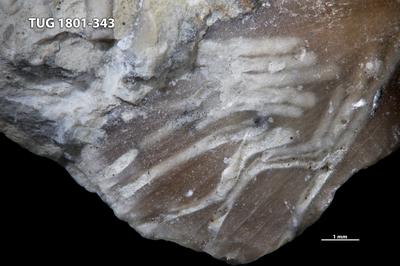
Palaeosabella Clarke, 1921
| ID | 11129 |
|---|---|
| Fossil group | Bioerosional trace fossils |
| Taxon | Palaeosabella |
| Author | Clarke, 1921 |
| Reference | Clarke, 1921 |
| Parent taxon | Gastrochaenolitidae |
| FAD | Tremadocian |
| LAD | Recent |
Includes:
Description(s)
Wyse Jackson & Key, 2007:
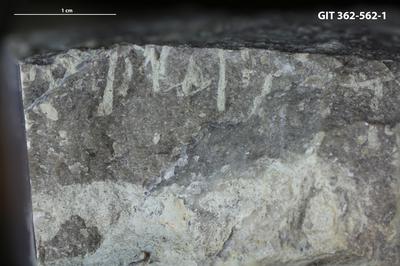
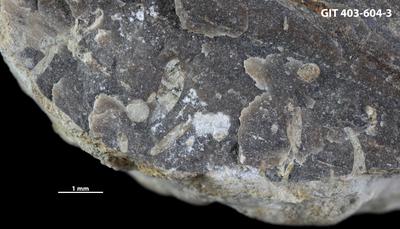
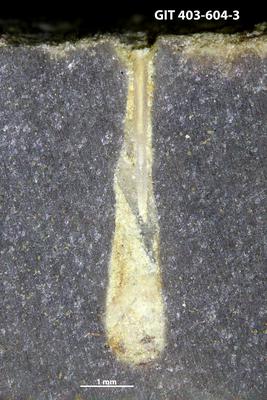
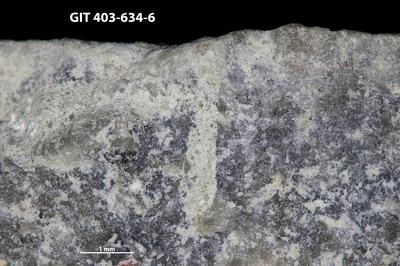
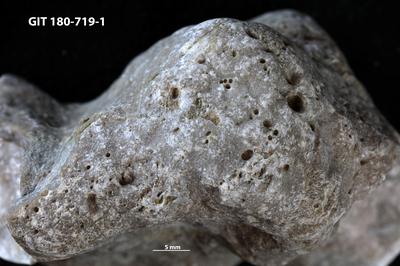
Palaeosabella is a clavate boring with length-to-width ratio of < 10:1, and although morphologically different from Trypanites, the two ichnogenera have often been confused.
Buatois et al., 2017:
Palaeosabella Clarke, 1921 is an elongated cylindrical boring with a swollen distal end formed in carbonate substrates. It is similar to Trypanites except for the clavate expansion at its termination. Palaeosabella has a complicated ichnotaxonomic history. It was considered nomen dubium by Teichert (1945), resurrected by Plewes (1996), Bromley (2004) and Wilson (2007), and erroneously considered a junior synonym of the later established Clionoides Fenton and Fenton, 1932 by Furlong and McRoberts (2014). We are here considering Palaeosabella a valid ichnotaxon because it does not branch like Clionoides.
Taylor & Wilson, 2003:
Remark: Unbranched, cylindro-clavate borings.
Knaust, 2012a:
Unbranched, cylindrical.
Buatois et al., 2017:
Category of architectural design: 2.66. Clavate-shaped borings.
Specimens with images (13)